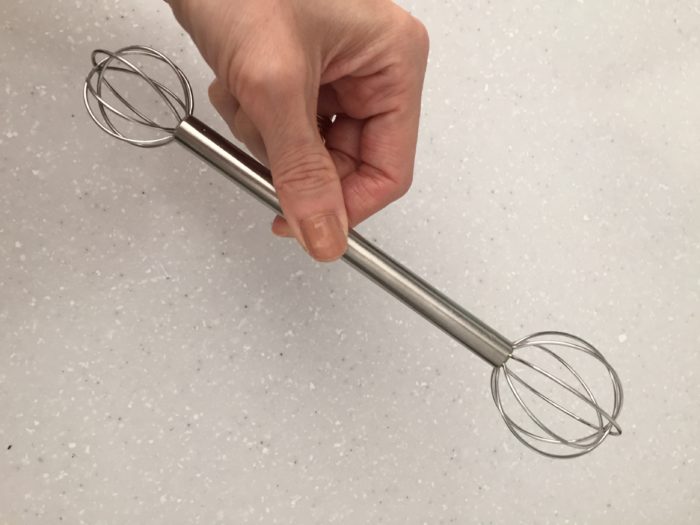
The miso muddler is a thoughtfully designed Japanese kitchen tool made especially for preparing miso soup, a staple of everyday home cooking in Japan. Its rounded, spiral-shaped tip allows you to scoop up miso paste easily and dissolve it directly into hot dashi, helping the miso blend quickly and smoothly without clumps. Compared to using a ladle or chopsticks, it distributes flavor more evenly and saves time.
At first glance, many people are curious about how to use this unique tool, but once they try it, they’re often impressed by how simple and efficient it is. If you’ve ever found your kitchen counter crowded with utensils while cooking—especially when trying a new recipe—the miso muddler offers a smart, space-saving solution.
Before using a miso muddler, I used chopsticks in one hand and a spoon in the other, and dissolving miso took time and effort. With this tool, you can cook using just one hand while the miso dissolves effortlessly in the broth. The dual-ended design also makes measuring easy: the larger end holds approximately 2 tablespoons, while the smaller end measures 1 tablespoon, helping you achieve consistent results every time.
Although it’s called a miso muddler, its versatility goes far beyond miso soup. It’s perfect for mixing homemade dressings, blending eggs, stirring small amounts of batter, or working with paste-like ingredients such as peanut butter or sesame paste. Simple, practical, and easy to clean, this tool embodies the quiet ingenuity of Japanese kitchenware. Once you start using it, it quickly becomes an everyday essential.
One of the most delicious summer foods is shaved ice with shaved ice shavings. In Japan this year, shaved ice coated with fresh cream and topped with fruit to resemble shortcake is very popular. Shaved ice stores offering shaved ice made with natural ice to make it fluffy have long lines of customers every day. This shaved ice machine is convenient for those who want to eat it at home. Since it is an automatic type, shaved ice can be made simply by pulling the lever on the right side toward you.
The lightweight cup for Japanese rice is 1 cup (180 ml) and it is called “1 合(Ichi Gou)”. The key to cooking good rice is not to wash the rice too much. Soak the rice once in water, then discard it and stir it without water. A milky, starchy liquid will come out, which is then poured off. Repeat this two or three times until the water becomes slightly clear. Then cook the rice in a regular Japanese lightweight cup with 200 ml of water per cup.
Measuring cups are useful for anything. Japanese measuring cups have a standard maximum capacity of 200 ml, so please keep this in mind when preparing Japanese dishes. In this video, I used a measuring cup to make mentsuyu (Japanese noodle soup). This soup is a bit thick, so please dilute it with water or hot water to your liking. It can be used as a sauce for noodle dishes such as udon, soba, and somen, as well as for simmered dishes, etc. It is very versatile, so please try making it!
An indispensable part of Japanese cooking is the chopsticks called “Saibashi”. They are longer than the chopsticks used for eating, and are used not only while cooking, but also when dividing food among plates. Normally, only two chopsticks are used, but this time I will introduce the cooking chopsticks along with some dishes where using four of them is convenient.
Mortar and pestle is said to be “Suribachi” and “Surikogi” in Japanese. A characteristic of Japanese mortar and pestle is that it has ridges on the surface of the the mortar make it easy to crush ingredients to some extent without exerting much effort. And because they are made of ceramic, they are lightweight, and final product can be displayed on the dining table as they are.
Do you like gyoza? I love gyoza, so I often make them at home. And I use this gyoza spatula when I do. Of course, you can use a spoon, but this tool is very time-saving because it allows you to quickly put the right amount of ingredients on the gyoza skin and spread it nice and thin. And of course, it can be used not only for dumplings, but also for spreading jam or butter on toast. For Gyoza & Gyoza Pastry recipe, please visit my food blog “YUCa’s Japanese Cooking”!
Have you all heard of Okonomiyaki? In Japan, we use this kitchen tool for this dish, I thought I’d give it a whirl and see what it can do for okonomiyaki! This oil container has a brush so that just the right amount of oil can be drawn thinly and evenly over the pan.
Do you have leftover food scraps scattered all over your workbench while cooking? In such cases, I would like to recommend this Multi-Eco Stand. I love it so much that I use it every time I use it on my recipe video channel. If you don’t like to use plastic bags, I recommend covering them with bags made of newspaper or paper. Aside from being a trash can, it can also be used as a holder to dry glasses, cups, etc. It can be folded compactly for easy storage.
In Japan, we use this drop Lid called “Otoshibuta” when we cook simmered or stir-fried dishes. People sometimes use wooden ones or cooking sheets, but I like this product because it can be easily adjusted to fit the size of my pots and pans. Regardless of its appearance, it is also easy to wash. It’s thin and small and it’s also convenient for storage.